
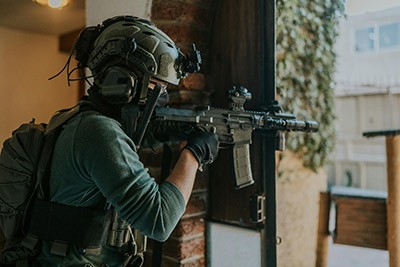






On the battlefield filled with bullets and shells or in dangerous scenarios where sudden violent incidents occur, bulletproof vests have become an important line of defense for safeguarding lives. It may seem ordinary, but it is equipped with advanced technology and exquisite design, capable of withstanding the fatal impact of bullets at critical moments and providing the wearer with a precious chance of survival. So, why exactly can bulletproof vests prevent bullets? This involves knowledge from multiple fields such as materials science, mechanical principles, and structural design.
Ii. The Material Secrets of Bulletproof Vests
(1) High-performance fiber materials
High-performance fiber materials commonly used in bulletproof vests, such as Kevlar and ultra-high molecular weight polyethylene (UHMWPE), have extremely high tensile strength and toughness. Take Kevlar as an example. Its strength is five times that of steel of the same mass, but its density is only one fifth of that of steel. When a bullet hits a bulletproof vest, these fibrous materials will rapidly stretch and deform. The interaction between fibers causes the bullet to constantly encounter resistance during the penetration process. The kinetic energy of the bullet is absorbed by the stretching and deformation of the fibers. The fibers disperse the bullet's energy through their own elasticity, preventing the bullet's energy from concentrating at a single point and thereby reducing the bullet's penetration ability.
Ultra-high molecular weight polyethylene fibers also perform well, featuring low density and high modulus. Its molecular chains are very long and the intermolecular forces are strong, which endows the fibers with excellent mechanical properties. During the bulletproof process, it can, like Kevlar, efficiently absorb and disperse the kinetic energy of the bullet through a multi-layer interwoven structure.
(2) Ceramic materials
Alumina ceramics, boron carbide ceramics, etc. are often used in the bulletproof inserts of bulletproof vests. Ceramic materials have extremely high hardness. When a bullet strikes the ceramic insert plate, the ceramic, relying on its own high hardness, causes the bullet to break and deform. The process of a bullet breaking consumes a large amount of kinetic energy. Meanwhile, the breaking of ceramics will also produce cracks, which will spread outwards from the point of impact, further consuming most of the energy of the bullet body.
However, ceramic materials are relatively brittle and prone to fragmentation. To solve this problem, it is usually used in combination with other materials such as fiber materials. Fiber materials can play a role in fixing ceramic fragments and further buffering energy, preventing ceramic fragments from causing secondary injuries to the wearer.
(3) Metal materials
In the past, some bulletproof vests would use metal materials such as steel plates. Metals can withstand bullets due to their high strength and hardness, but they are often heavy, which can affect the flexibility and comfort of the wearer. Nowadays, metal materials are mostly used as part of composite protection systems or in some specific protection scenarios where weight requirements are not so strict. For instance, in some armored vehicles, metal plates can be combined with other bulletproof materials to offer greater protective capabilities.
Iii. Structural Design of Bulletproof Vests
(1) Multi-layer protective structure
Bulletproof vests usually adopt a multi-layer design, and each layer undertakes different functions. The outer layer is generally made of sturdy fabric, which not only provides water and stain resistance but also ensures that the inner layer material will not be damaged by the influence of the external environment. It can also resist the direct impact and friction of bullets to a certain extent.
The ballistic layer is the core part of a bulletproof vest and is usually composed of materials such as Kevlar fibers, polyethylene or ceramic plates. This layer is responsible for dispersing and absorbing the kinetic energy of most of the bullets. Ballistic layers made of different materials have distinct characteristics. For instance, Kevlar fiber ballistic layers possess excellent flexibility and energy absorption capacity, while ceramic plate ballistic layers feature high hardness and highly efficient energy dispersion.
The cushioning layer is also added to some high-end bulletproof vests. It is usually made of materials such as closed-cell knitted composite fabric and soft polyurethane foam plastic. The function of the buffer layer is to further reduce the impact force after the bullet strikes and minimize the harm to the body. When the remaining energy of the bullet is transferred to the buffer layer, the buffer layer will deform, further absorbing and dispersing the energy.
(2) Modular design
Modern bulletproof vests are increasingly adopting modular designs. For instance, the "Interceptor" bulletproof vests used by the US military on the Iraq battlefield adopted a modular design concept. It uses KM2 high-strength aramid synthetic fiber as the bulletproof layer material. Meanwhile, the bulletproof plates and protective components can be flexibly replaced according to different mission requirements and threat levels. This design enables bulletproof vests to adapt to different battlefield environments, enhancing their versatility and protective effectiveness.
Iv. The Bulletproof Principle of Bulletproof Vests
(1) Energy conversion mechanism
The core principle of bulletproof vests is to convert the kinetic energy of bullets into other forms of energy. When a bullet is shot at the wearer, the material of the bulletproof vest will come into contact with the bullet, generating an instantaneous collision and friction effect. During this process, the kinetic energy of the bullet is converted into the internal energy of the material (such as thermal energy), sound energy and deformation energy of the material.
For instance, when bullets rub against bulletproof fibers, a large amount of heat is generated. This heat raises the temperature of the fibers, and part of the kinetic energy is converted into heat energy and dissipated. Meanwhile, the stretching and deformation of fibers also absorb a large amount of energy, converting the kinetic energy of the bullet into the deformation energy of the material. In addition, the sound produced when a bullet collides with bulletproof material is also a manifestation of the conversion of kinetic energy into acoustic energy.
(II) Principle of Pressure Dispersion
Bulletproof vests disperse the impact force of bullets over a larger area through their materials and layered structure. When a bullet hits a bulletproof vest, the outer material first bears the impact of the bullet and transmits part of the force to the next layer. The superposition of multiple layers of materials gradually disperses the impact force of the bullet, making it no longer concentrated at a single point.
Take soft bulletproof vests as an example. The multi-layer Kevlar fiber fabric disperses the impact force of the bullet throughout the bulletproof area through the interaction between the fibers. Each layer of fibers bears a portion of the force, which greatly increases the difficulty for bullets to penetrate. Just like a net, when it is impacted by an external force, the force will be distributed to each node of the net, thus avoiding excessive local force and damage.
(3) Material Damage and Energy Absorption
When a bullet hits bulletproof material, the material will be damaged, and this process of damage will also absorb a large amount of energy. For high-performance fiber materials, the fibers will tear layer by layer. The breakage of fibers, the disintegration of yarns and fabric structures, and other fabric damage methods all consume the kinetic energy of bullets.
For ceramic materials, the impact of bullets will cause cracks and fractures in the ceramics, and these destructive processes will consume most of the energy of the bullet body. Metallic materials also absorb energy during deformation and fragmentation. The degree of material damage is related to the kinetic energy of the bullet. The greater the kinetic energy, the more severe the material damage, but it also means that more energy is absorbed.
V. Protection Levels and Limitations of Bulletproof Vests
(1) Protection grade
Bulletproof vests come in various protection levels. For instance, the NIJ (National Institute of Justice of the United States) standard divides them into multiple grades, ranging from resisting low-speed pistol ammunition to defending against high-speed rifle ammunition within a certain distance, among others. Bulletproof vests of different grades vary in material selection, structural design and other aspects. Low-grade bulletproof vests mainly use thinner fiber materials and have relatively weak protective capabilities. High-grade bulletproof vests, on the other hand, will adopt thicker fiber layers, harder ceramic inserts, etc., providing stronger protection.
(2) Limitations
Although bulletproof vests have strong protective capabilities, they also have certain limitations. First of all, bulletproof vests cannot completely block all types of bullets. For some large-caliber and high-speed bullets, even high-grade bulletproof vests may not provide effective protection. Bullets still have the potential to penetrate the bulletproof vest and cause fatal harm to the human body.
Secondly, even if the bulletproof vest blocks the bullet, the huge impact force of the bullet can still be transmitted to the human body, which may cause serious blunt contusions such as fractures and internal organ ruptures. If the injury is severe and not treated in time, it can still be life-threatening.
Vi. Conclusion
The reason why bulletproof vests can resist bullets is the result of the combined effect of multiple factors. High-performance bulletproof materials, reasonable structural design, and bulletproof principles such as energy conversion and pressure dispersion enable bulletproof vests to provide effective protection for the human body at critical moments. However, we should also recognize the limitations of bulletproof vests, as they cannot guarantee absolute safety. In the future, with the continuous advancement of technology, the materials and designs of bulletproof vests will be constantly improved, and their protective capabilities will also be continuously enhanced, providing more reliable protection for people's lives and safety. At the same time, we should also fundamentally reduce the demand for bulletproof vests by strengthening social security and reducing violent conflicts, so as to make the world more peaceful and safe.